


| 2) What size T'Blade Runner/Rocker should I purchase? |
|
Determining the correct rocker &
hollow size, most skates that already come equipped with the tblade
system are stocked with M/13. This seems to be the standard/middle of
the road size. A good rule of thumb to keep in mind is a long rocker
will give you better stability; while a short rocker is best for
agility. For example a defenseman may prefer a long rocker, while a
forward may like skating on a short rocker. Most skaters will start out
with a Medium rocker & go on from there.
In regards to the blade hollow, a smaller size (such as “9mm”) has a
more aggressive edge, that is to say it cuts into the ice more than a
larger hollow (15mm or 18mm for example). A larger hollow will give the
skater a better glide than a smaller hollow.
Needless to say, personal preference plays a big role in which size will
work best for you. |
| |
| 3) What is my skate size based on my UK/EURO shoe size? |
- A UK 8 shoe size (for example)
is typically a US size 9 shoe…. Here is a guide to help with
shoe size conversion concerning US/UK/EURO sizing:
 |
Each skate
manufacturer uses different sizing, CCM, RBK, Easton,
Bauer and Graf recommended going a size to a size and a
half down from your US Mens shoe size. Other brands such
as Mission and some Nike skates usually fit equal to US
shoe sizing*. We have an approx sizing chart on our site
(http://www.hockeymonkey.com/sizingcharts.html)
but it is highly recommended to have the skates fitted
at a local pro shop before hand, as sizing is NOT
guaranteed.
Concerning skate widths, “D” is the standard, “C” is
about a quarter of an inch narrower than “D”, while “E”
(or “EE” depending on the manufacturer) is about a
quarter of an inch wider than “D.” Some skate models may
designate “N” for Narrow/C width, “R” for Regular/D
width and “W” for Wide/EE width. CCM skates usually have
the widest boot construction available, while Nike
skates seem to run narrow in general.
*Older model Nikes (Quest 1 & 2) are usually the same as
shoe size, to a half size down. Newer model Nike skates
(Roller Dads, Shadows, Silvers) are a size, to a size
and a half down from your US Men’s shoe size. |
|
|
Back to the Top
| 4) I though T'Blades couldn't be sharpened. How do I use the T'Blade sharpening stone? |
|
The sharpening stone is used primarily
to smooth out the nicks on the side of the blade. To use, please use the
guide below. Hold the stone in
your right hand. The flat part should be facing up. Run the stone along
the side of the runner, smoothing out the imperfections. If you need
further assistance, please call 888.286.6169 or 888.945.4295. |
| |
| 5) I see several products with the letters SMU/THG in their description. What does this mean? |
|
SMU stands for "Special Make Up" which
is another way to say "limited edition." SMU Products are purchase by
The Hockey Group (THG) which HockeyMonkey is a part of. THG is a group
of buyers who pool their recourses to purchase in bulk quantities from
manufacturers. Often, manufacturers offer an exclusive skate to THG
which is very similar (often higher quality) to the model above in cost.
Since this SMU model is not mass-produced/marketed & not available most
anywhere else, we can offer the skate below what the skate would fetch
in the retail market.
For more information, please visit
http://www.thehockeygroup.com. |
| |
| 6) What is the difference between D, E & EE in skate sizing? |
|
In regards to skate widths, “D” is the
standard, “C” is about a quarter of an inch narrower than “D”, while “E”
(or “EE” depending on the manufacturer) is about a quarter of an inch
wider than “D.” Some skate models may designate “N” for Narrow/C width,
“R” for Regular/D width and “W” for Wide/EE width. CCM skates usually
have the widest boot construction available, while Nike skates seem to
run narrow in general. |
| |
| 7) What kind of skate will work best for me? |
|
There are several different variables
such as, will you be playing in a league, if so what type, how often
will you be on the ice, ect ,ect… which unfortunately make it very
difficult to determine which skate would work the best according to your
needs. Please call Customer service at 888.286.6169/951.271.4159 or
contact or Pro Shop @ 888.945.4295/714.210.2976 for a recommendation. |
| |
| 8) How should I install a replacement blade into a shaft? |
|
Tools Required:
In most pro shops a Multi-Purpose heat gun is used. These can be
purchased at a hardware store, usually between $50-$70 US. There
are usually two heat settings on your most basic heat guns; it’s
recommended to use the higher of the two…most likely a hair
dryer isn’t going to work.
Some will use a gas range stove; however this is strongly
ill-advised, as there are obvious fire hazards attached to this
method.
If extracting a broken blade, you may need a vice of some sort
and/or needle-nosed pliers to help you out with the tiny pieces.
Sometimes you can drill in a screw through the wood toward the
shaft hollow for something to hold onto.
Directions:
"Preheat your heat gun. Clamp
the blade in a vice so the blade toe is pointing in the air,
while the hosel points toward you. Heat the shaft approx. 3
inches from the bottom, where the hosel of the blade slides in.
Evenly heat all sides of the shaft to effectively loosen the
glue (It usually takes about a minute, sometimes longer
depending on how long the blade has been in use).
"As it the glue heats, it will
loosen as well. Continue to apply the heat while simultaneously
pulling on the shaft. Slowly the blade will begin to slide away
from the shaft. If possible, have one person pull on the shaft,
while another continues to heat the blade.
"Once the blade is out, it's
time to install the new blade. Most will come "pre-treated" with
dried glue already on to the hosel. It's recommended to add
additional glue for more stiffness and stability. Place the new
blade in the vice, the same way as the old blade. Heat the glue
on the hosel of the blade until it's bubbling a little bit (Do
NOT touch the glue! Needless to say it is very hot & can cause
mild to sever burns). Ensure the glue is evenly melted on all
sides of the hosel, however don't over-heat the glue to the
point it's dripping everywhere!
"Once the glue has been heated
on all sides, insert the blade into the shaft slowly, letting
the glue harden as you're sliding the replacement blade in. The
glue will harden quickly with no heat. You don't need to heat up
the shaft again.
"Wipe away the excess glue
that might have been squeezed out (and/or wrap the area were the
shaft & hosel join with cloth tape for maximum stiffness) and
viola you're done! Please make sure the glue has cooled down
completely before use.
The Fine Print - Please note, this guide is to be used for
reference only, HockeyMonkey.com assumes no liability for
damaged or un-useable shafts & blades. As always it is best to
have blades installed by a professional.
|
|
| |
Back to the Top
| 9) I'm just starting out, what should I look for in terms of what equipment to buy? |
|
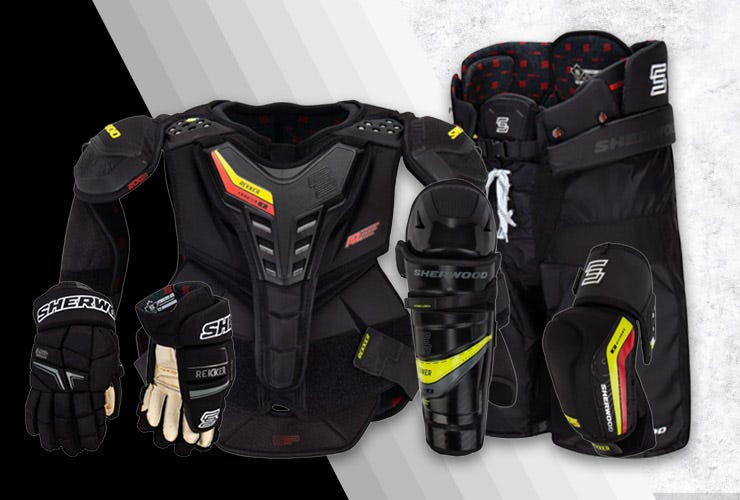
It can seem overwhelming at times when
buying hockey equipment for the first time, so we’ve provided a list of
the gear necessary (and required by most leagues) for play.
Please be advised, if you have a little extra money to spare, put it
towards the helmet and the skates. A helmet is the most important
component of your protective equipment. In general, helmets usually last
about 2-3 years for kids, and much much longer for adult wearers.
Concerning skates, there is no other part of your equipment that will
have as much of a dramatic effect on your style & performance; a little
investment goes a long way.
*Helmet
Must be HECC Certified. (For Players under 18, a full shield is
required)
*Mouth Guard
Higher Quality mouth guards will conforms to the shape of the mouth
better, resulting in better comfort.
* Shoulder Pads
Protects Chest, Shoulder & Sternum. (Optional for Roller)
*Elbow Pads
Protects forearms from slashing, as well as elbows from impact & falls.
*Hockey Gloves
Provides protection for the hand & wrist. Higher quality models will
give the wearer better flexibility with "split finger" or "three finger"
design.
*Protective Cup/Pelvic Protector
*Hockey Girdle
Roller - Provides Hip Tailbone & Thigh protection. Lightweight &
Ventilated.
Ice - Some players will use either a girdle & shell combination, or Ice
Hockey Pants. With a Girdle/Shell, you can change the color with a
different colored shell, rather then having to purchase a pair of Ice
Hockey pants. It's a matter of preference really; however Ice Hockey
Pants seem to be more popular.
*Hockey pants
Ice - Protects Hips, Tailbone & Thighs. Should be long enough to reach
the top of the shin guard. Some brands offer a "short" or "tall" design
to suit your preference in pant length.
Roller - Long shell-type pants to cover your shin guards & girdle
(girdle optional).
*Shin Guards
Protects your Knee & Shins from sticks, pucks & impact from hitting the
boards or ice. Ideally, these should fit an inch or so below the top of
the skate boot.
*Skates
Affects your skating speed & ability. One of the most important pieces
of your equipment, both Ice & Roller.
*Hockey Stick Most any stick with a stiff non-plastic
blade at least 2" wide should work. When Upright, the stick should reach
the players nose (with skates on it should reach the bottom of your
chin). A defenseman may want to use a longer stick to give them a longer
reach for poking the puck away and a forward may want to use a shorter
stick to help them stickhandle better.
Sizing Guides -
http://www.hockeymonkey.com/sizingcharts.html |
| |
| 10) Will Abec 9 bearings make me skate faster than Abec 5 bearings? |
|
ABEC doesn’t affect the speed of your
skates…not unless you’re skating at extreme speeds (around 330 mph)!
ABEC rating is based on a 608 bearing limiting speed of 32,000 rpm. Only
in high speed applications such as ultra high speed motors and precision
measuring instruments can bearings above ABEC 1 affect performance.
Regardless of how fast you plan to go, speed is affected by the choice
of lubricant.
The fit of your wheels and axles have a greater effect on performance
than ABEC rating. Wheels and axles have a very loose fit which allows
you to press the bearings into the wheel by hand. This virtually erases
the benefits of a higher precision bearing by allowing it to slip on the
axle or in the wheel. Slippage between the parts results in energy loss.
Lost energy = lost speed. The higher the ABEC rating, the less rolling
resistance there will be. An ABEC 7 should roll faster than an ABEC 5 by
the same vendor. In addition, the higher the rating the softer the metal
becomes and the quicker it wears. |
| |
Back to the Top

|