Now I have everything I need. Let me craft a comprehensive, authoritative buying guide that outclasses the competition.


Hockey Neck Guards Explained: Rules, Fit, Safety, and Buying Guide

Your neck holds your carotid arteries, your jugular vein, and your airway. One errant skate blade — in a fall, a collision, or a crease scramble — can reach any of them in a fraction of a second. Hockey neck guards exist for exactly that reason, and after the tragic death of Adam Johnson in October 2023, the entire hockey world got serious about them fast.

Whether you're a parent outfitting a Mite, a beer leaguer who's been skipping this piece of gear for years, or a travel player making sure you're league-compliant, this guide covers everything: the current rules, how to get the right fit, what the certifications actually mean, and which guard to buy at every price point.


Why Neck Guards Matter: The Real Risk

The primary purpose of a hockey neck guard is to protect the player's neck from cuts caused by skate blades. In a fast-paced sport like hockey, accidents can happen — and the neck, being a highly vulnerable area, requires extra protection. A skate blade to the neck could sever vital arteries such as the jugular or carotid, which can lead to life-threatening injuries.

As Dr. T. Sean Lynch, a sports medicine and orthopedic surgeon at Henry Ford Health puts it: "Life-threatening injuries can occur from a skate blade to the neck, as that area holds the vital arteries."

This isn't a theoretical risk. Neck protection became a front-burner issue in the hockey world after the tragic death of Adam Johnson — who sustained a fatal skate laceration to the throat during an Elite Ice Hockey League game in October 2023. Johnson's death wasn't just a devastating loss — it became a catalyst for sweeping safety reforms across global hockey. In the aftermath, leagues from youth hockey to professional ranks scrambled to implement mandatory neck guard policies.

The neck guard isn't a burden. It's the cheapest insurance policy in your bag.


Hockey Neck Guard Rules by League

> Quick Answer / TL;DR
> - Under 18 in the USA? Neck guard required since August 1, 2024.
> - Hockey Canada youth? Mandatory for all players under 18.
> - CHL/AHL? Mandatory for all players.
> - NHL? Not mandatory — but strongly encouraged.
> - Adult rec/beer league? Check your local league, but strongly recommended regardless.

USA Hockey

The USA Hockey Congress approved legislation at its Winter Meeting on January 28, 2024, requiring the use of neck laceration protection for players in all age classifications other than adults — in games and practices, as well as for on-ice officials under the age of 18 — beginning August 1, 2024. This includes youth, girls, and junior age classifications.

Rule enforcement is the same as any other equipment violation: an initial team warning followed by a 10-minute misconduct penalty for any violations after the initial warning.

Can a parent waiver exempt a player from wearing neck protection? No, it cannot.

USA Hockey continues to strongly recommend the use of neck laceration protectors for adult players.

Hockey Canada

Hockey Canada implemented mandatory neck protection for all players under 18 across all levels of play. The requirement specifies BNQ 9300-040 certification. This includes minor hockey, female hockey programs, and junior development leagues under Hockey Canada's jurisdiction. Hockey Canada has required neck protection for youth and female hockey players since 1993.

Major Junior (CHL) & AHL

The Canadian Hockey League — encompassing the OHL, WHL, and QMJHL — made neck guards mandatory for all players starting in the 2024–25 season. This marked a significant shift for major junior hockey, where neck protection had previously been optional. The CHL requires guards meeting BNQ 9300-040 standards.

The American Hockey League mandated the use of cut-resistant neck protection for all players and on-ice officials, with the changes going into effect for the 2024–25 season following a unanimous vote by the AHL board of governors. All AHL players, referees, and linespersons must wear approved cut-resistant neck protectors.

IIHF & European Leagues

In the IIHF Official Rule Book, as of the 2024–25 season, Rule 9.12 now reads: "For all players in all categories of IIHF Competition, it is mandatory to wear a neck laceration protector designed for this specific purpose, choosing a design that covers as much of the neck as possible." The Neck Laceration Protector must be properly worn and must not be modified or altered in any way.

NHL

The NHL does not require neck guards for players. The league has historically taken a player-choice approach to optional safety equipment. Following the Johnson incident, the NHL and NHLPA jointly encouraged players to consider neck protection but stopped short of mandating it.

NCAA

NCAA hockey does not currently mandate neck guards at the Division I, II, or III levels. However, individual conferences and schools can implement their own requirements. Several programs and conferences strongly encouraged neck protection following the Johnson tragedy, but NCAA-wide mandates have not materialized as of the 2025–26 season.


Types of Hockey Neck Guards

Not all neck guards are built the same. There are three main styles, each with distinct trade-offs.

1. Traditional Collar (Velcro Strap)

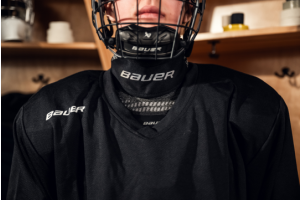
Traditional neck guards are typically made from ballistic nylon or foam padding and attach to the collar of a hockey jersey or base layer. Products like the Bauer NG21 represent this category. They're designed to protect against cuts from skate blades but vary in coverage area and thickness.

Best for: Youth players, budget-conscious shoppers, players who want simplicity.

2. Integrated Base Layer Shirt

Cut-resistant base layers incorporate materials like Kevlar or other cut-resistant fabrics into shirts, compression gear, or standalone neck pieces. Brands like Bauer and CCM have developed base layers with integrated neck protection that meet various safety standards.

Designed as an all-in-one base layer, these garments feature DuPont™ Kevlar® fibers in the neck collar area and comfortable, moisture-wicking fabrics through the arms and torso to keep you feeling fresh all game long.

Best for: Players who want seamless integration and don't want to deal with a separate collar shifting during play.

3. Bib-Style Guard

A traditional collar extended with a chest/bib section for extra front coverage. The bib style should come down to the upper chest, offering complete coverage to the throat.

Bib-style guards are often preferred for goalies, adding extra protection around the chest and back, along with the neck.

Best for: Goalies, defensive players who spend time in front of the net.


Certifications Explained: BNQ, HECC, ASTM, and More

This is where most buying guides fall short. Here's what the labels actually mean.

In 2025, HECC launched a new certification program specifically for neck laceration protectors. Products must pass testing under ISO 10256-5, an international safety standard for hockey protective equipment. Testing and validation are performed through approved certification bodies such as CSA Group.

Once certified, the product receives the official HECC certification mark, confirming it meets USA Hockey's compliance requirement. HECC certification ensures that products meet baseline performance and manufacturing standards designed to protect players from serious injury.

Here's a plain-language breakdown:

CertificationIssuing BodyWhat It MeansRequired By
BNQ 9300-040Bureau de normalisation du QuébecCut-resistance standard for hockey neck guardsHockey Canada, CHL, USHL
ASTM F3145-22ASTM InternationalU.S.-based cut-resistance standardUSA Hockey
HECCHockey Equipment Certification CouncilIndependent product certification for USA Hockey complianceUSA Hockey (2025 onward)
CEEuropean ConformityEuropean safety standardIIHF-affiliated leagues
ISO 10256-5International Organization for StandardizationInternational hockey protective equipment standardUnderpins HECC testing

Two neck guards can both meet the USA Hockey compliance requirement while offering very different levels of protection. That's because certification standards establish a minimum safety threshold, not the highest level of protection available.

The bottom line: Always buy a certified guard. But don't stop there — look at cut-resistance ratings too. Look for ANSI cut resistance levels of A6 or higher, with A8–A9 representing elite protection.


How to Get the Right Fit

Fit is not optional — a neck guard that shifts around during play is barely better than no guard at all.

Step 1: Measure Your Neck

Use a soft tape measure to wrap around your neck, just below the Adam's apple. Be sure to leave enough room for comfort.

Anything above 14 inches is generally an adult-sized neck protector.

Step 2: Choose the Right Size

If you are between two neck guard sizes, it's best to choose the one that offers the most coverage without being loose and that can stay firmly secured against the neck without restricting your range of motion.

Step 3: Check Coverage

The neck protector should be snug but not uncomfortably tight. It should completely cover the throat, and with the bib style, the upper chest area.

Step 4: Test Your Range of Motion

Just as you would walk around in shoes before buying a pair, move your head from side to side and up and down to make sure your neck guard fits properly.

Fit Red Flags to Avoid

  • Gaps at the sides — the jugular vein runs along the side of your neck
  • Riding up when you skate or look down
  • Twisting or rotating out of position during play
  • Fitting too loosely — any loose or movable protection around the neck will not safely shield your neck


Hockey Neck Guard Comparison Table

ProductStyleCertificationCut ResistanceBest ForPrice Range
Bauer NLP7 Neck GuardCollar/BibBNQ, CEMidYouth & Junior, Budget$
Bauer NG21 Premium CollarCollarBNQ, CEMid-High (Kevlar)All players, everyday use$$
Bauer LS Neck Protect Base LayerBase Layer ShirtBNQ, CEMid-High (Kevlar)Players wanting all-in-one$$
Bauer Pro Certified Neck GuardCollar + CURV CompositeBNQ, HECCHigh (Kevlar + CURV)Competitive/Elite players$$$
CCM Tacks Neck GuardCollarBNQMidYouth, budget-friendly$
CCM Cut-Resistant Neck Guard ShirtBase Layer ShirtBNQMidYouth & Intermediate$$
Warrior AK1 Neck GuardCollarBNQ, CEMid-HighSr. Rec to Competitive$$

$ = Under $30 | $$ = $30–$60 | $$$ = $60+


Our Top Picks by Player Type

Youth Players (Under 12) — Best Value with Compliance

[PRODUCT_CARD: Bauer NLP7 Youth Neck Guard | https://www.hockeymonkey.com/equipment/neck-guards/ | ~$19.99 | BNQ & CE Certified | Adjustable Velcro strap | Lightweight foam + cut-resistant shell]

Why we like it: It ticks every compliance box for USA Hockey and Hockey Canada, fits small necks properly, and won't break the bank. Simple, reliable, stays put. Perfect for Mites through Peewee.


Junior & Teen Players (12–17) — Best All-Around

[PRODUCT_CARD: Bauer NG21 Premium Cut-Resistant Neck Guard Collar | https://www.hockeymonkey.com/equipment/neck-guards/ | ~$34.99 | DuPont Kevlar cut-resistant fibers | BNQ & CE Certified | HeiQ Fresh odor-control technology]

The Bauer NG21 is designed with soft polyester and para-aramid fibers to remain comfortable and non-intrusive during play. It is BNQ and CE certified, features HeiQ® Fresh™ technology to neutralize odors naturally, and uses an easy-close adjustable collar for a customized fit. The Kevlar reinforcement puts it well above entry-level collars.


Adult Rec & Beer League — Best "Set It and Forget It"

[PRODUCT_CARD: Bauer LS Cut-Resistant Neck Protect Base Layer Senior | https://www.hockeymonkey.com/equipment/neck-guards/ | ~$49.99 | DuPont Kevlar neck collar | BNQ & CE Certified | Moisture-wicking base layer integration]

This all-in-one base layer features DuPont™ Kevlar® fibers in the neck collar area and comfortable, moisture-wicking fabrics through the arms and torso. You put it on like a regular undershirt — the neck protection is just built in. No separate collar to forget in your bag.


Elite & Travel — Best Protection

[PRODUCT_CARD: Bauer Pro Certified Neck Guard Senior | https://www.hockeymonkey.com/equipment/neck-guards/ | ~$69.99 | BNQ + HECC Certified | Kevlar cut-resistant fibers + CURV composite collar | Premium construction for competitive play]

The Bauer Pro Certified Neck Guard features an elite level of protection with a BNQ-certified Kevlar-reinforced neck, a CURV composite collar, and nylon liner. This is the one you want if you're playing at a high level and don't want to compromise anywhere on protection.


Goalies: What's Different for You

Goalies face a unique risk profile. You're low in your butterfly with shooters at the doorstep, and players crash the crease around you constantly.

Goalies can benefit from using both a cut-resistant hockey neck guard and a throat guard for maximum protection. The neck guard provides protection from skate blades, while the throat guard helps shield against hard shots.

Bib-style guards are often preferred for goalies, adding extra protection around the chest and back along with the neck.

The Bauer PRO Goalie Neck Guard features cut-resistant fabric in the neck and added impact protection across the clavicle area. It is designed to fit under existing chest protectors while remaining comfortable and non-intrusive.

Goalie shopping checklist:

  • BNQ or HECC certified (required for youth/junior)
  • Fits under your chest protector without bunching
  • Impact protection on the clavicle zone
  • Doesn't lift your mask or restrict head movement
  • Throat guard attachment or compatibility if your league requires it


FAQ

Do I legally have to wear a neck guard in hockey?
As of August 1, 2024, USA Hockey requires neck laceration protection for players in all age classifications other than adults — including youth, girls, and junior classifications — in games and practices. Hockey Canada has mandatory neck protection for all players under 18 across all levels of play. Adult players in the U.S. are exempt from the mandate, but strongly encouraged to wear protection.

What happens if a youth player shows up without a neck guard?
Rule enforcement is the same as any other equipment violation: an initial team warning followed by a 10-minute misconduct penalty for any violations after the initial warning.

What certifications should I look for on a hockey neck guard?
Look for BNQ 9300-040, ASTM F3145-22, HECC, or CE markings on the product. When selecting a neck guard, certification is crucial. Look for products with BNQ or CE certifications, which guarantee that the neck guard meets strict safety standards for cut resistance. Certification indicates that the neck guard has undergone rigorous testing to provide optimal protection against skate blade cuts.

Does the thickness of a neck guard matter?
The thickness of the neck guard doesn't necessarily matter, as long as it's made of a durable fabric like cut-resistant Kevlar — the same material used in bulletproof vests. Focus on material quality and certification, not bulk.

What's the difference between a neck guard and a throat guard?
A neck guard wraps around the neck to protect against skate blade lacerations. A throat guard (common for goalies) is typically a hard plastic piece that hangs from the mask to protect against puck impacts. Goalies often use throat guards in addition to traditional hockey neck guards. Throat protectors are often made of high-impact plastic and dangle from the goalie mask to cover the exposed throat.

Can I wear a base layer shirt instead of a separate neck guard?
Yes — cut-resistant base layers with integrated neck protection are increasingly popular and may be more comfortable than traditional collar-style guards. As long as the garment carries valid certification (BNQ, ASTM, or HECC), it satisfies the same rule requirement.

Is the NHL going to mandate neck guards?
The NHL does not currently require neck guards. The league has historically taken a player-choice approach, and following the Johnson incident, the NHL and NHLPA jointly encouraged players to consider neck protection but stopped short of mandating it. That said, adoption rates at the pro level have been climbing steadily.

How do I know when to replace my neck guard?
Replace it if the cut-resistant material shows signs of fraying, if the Velcro no longer holds a secure fit, or if the guard has been cut or significantly compressed. Don't wait for visible failure — if it's been through years of hard use, retire it.


Ready to gear up? Browse the full lineup of hockey neck guards at HockeyMonkey.com — certified options for every age, level, and budget. Your neck is worth protecting, and the right guard is in stock right now.